
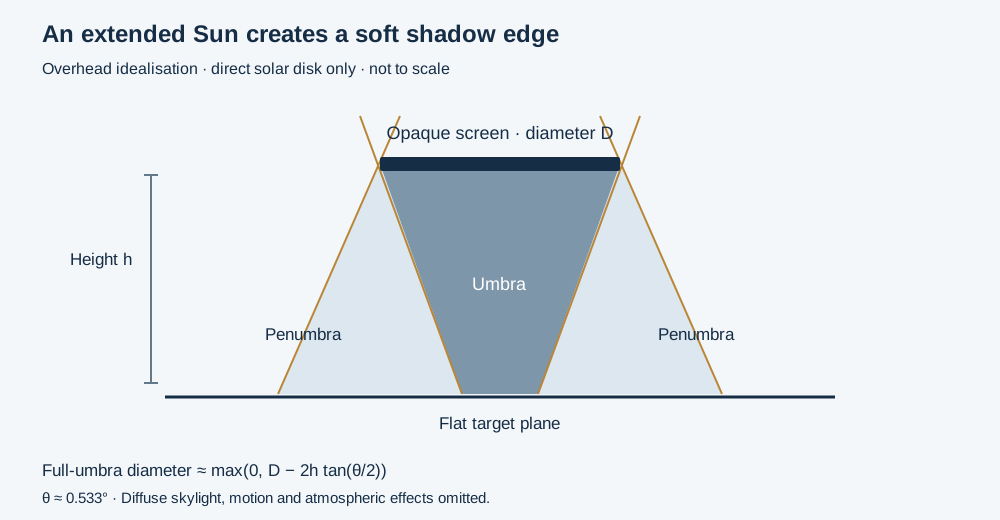
A finite Sun creates a penumbra
A ground observer sees a solar disk, not a point of light. Different rays from that disk pass opposite edges of a screen. Where the entire disk is obscured there is an umbra; where only part is obscured there is a penumbra. A surface in geometric umbra can still receive diffuse light scattered by the atmosphere.
The shadow’s footprint depends on screen size, height, orientation and the Sun’s position. A screen held in one position does not automatically hold its shadow over one ground location throughout the day.
An idealised calculation
For an opaque horizontal circular screen with the Sun directly overhead, let D be screen diameter, h its height above a flat target, and θ the Sun’s apparent angular diameter.
Umbra diameter ≈ max(0, D − 2h tan(θ/2))
Outer penumbra diameter ≈ D + 2h tan(θ/2)
NASA gives an apparent solar diameter of 1,919 arcseconds at one astronomical unit, about 0.533°. The expressions here are our idealised geometric derivation using that input; they are not a NASA assessment of ASES.
| Screen height | Screen diameter must exceed |
|---|---|
| 10 km | 93 m |
| 20 km | 186 m |
| 50 km | 465 m |
At 20 km, a 100 m screen has no full umbra in this model. A 1 km screen has a full-umbra diameter of approximately 814 m, with partial shading beyond it.
What these numbers do not establish
These calculations omit clouds, scattering, refraction, diffraction, screen deformation, motion and non-overhead solar angles. They describe direct-disk obstruction only. They do not predict temperature, rain or a platform’s ability to fly.
The proposed 10–50 km band also spans different atmospheric conditions. The tropopause varies with latitude and weather, so the entire band is not stratospheric everywhere. Engineering analysis must use the actual environmental profile.
Sources & further reading
These sources establish background context. They do not certify the ASES proposal or demonstrate its proposed applications.
ASES remains a research proposal. Atmosfrustology is the author’s proposed framework. No operational climate-control capability is established by this website.